You can close good deals.
But where do the next ten come from?
If your product works but acquisition feels unpredictable, the next step is to identify the weak link in your GTM system.
Your pipeline depends on you.
Referrals and founder relationships bring wins. A repeatable team motion is still missing.
Activity is up. Relevant conversations aren't.
Lists, tools and sequences exist—but targeting, timing and messaging don't connect.
You can't see what to fix next.
Meetings are counted. Qualification, conversion and pipeline contribution remain unclear.
Find the constraint.
Build the motion. Make it repeatable.
An ongoing engagement that connects commercial strategy, account intelligence and hands-on outbound execution. The first 90 days establish and test the foundation. Each month, we review evidence and refine the motion. Scope and targets are agreed after diagnosis.
Know what needs to change.
Baseline your funnel, work backwards from revenue, choose the highest-probability segment and map the pains and triggers that matter.
Outputs: GTM baseline · ICP · pain & trigger mapGive the right buyers a reason.
Research priority accounts, map stakeholders, develop relevant messages and test focused email and LinkedIn plays with human review.
Outputs: account briefs · messaging · campaign testsLearn what deserves to scale.
Track replies, qualified conversations and opportunities. Improve the weakest conversion and document the operating rhythm.
Outputs: scoreboard · qualification standard · playbookFrom “who should we target?”
to “why this account, now?”
Signal-to-Revenue is the developing intelligence workspace behind the method. It is being designed to organize research and priorities. Until the app is ready, the agreed consulting workflow is delivered with human review and existing tools.
Evidence before volume.
Assess fit, signal strength, pain evidence, buyer accessibility and commercial potential. Record what is known, what is inferred and what still needs verification.
The score is a research aid, not a prediction that an account will buy. This page shows an illustrative output, not a live product integration.
- Planned workspace: prioritized accounts with an explained score
- Planned workspace: account briefs and a clear “why now” hypothesis
- Planned workspace: relevant outreach drafts for human review
- Planned workspace: saved accounts and pipeline status visibility
- Weekly learning tied to commercial outcomes
A working GTM system.
Built around your business.
The first 90 days build tangible working assets and a weekly measurement rhythm. We keep improving these assets throughout the ongoing partnership. Final scope is confirmed in your proposal.
Assess your fit ↗- Revenue-to-pipeline baseline
Targets, funnel assumptions and the constraint to address first. - ICP and priority-account criteria
A defined segment, buying triggers and research standards. - Account briefs and stakeholder maps
Evidence, pain hypotheses and people to engage. - Messaging and campaign test plan
Relevant angles, outreach drafts and an experiment log. - Qualification and weekly scoreboard
A shared definition of an opportunity and visibility into conversion. - Living operating playbook
Documented learning, ownership and next actions.
A signal is a starting point.
Evidence determines the action.
Here is an illustrative workflow for a SaaS business entering a new market. It demonstrates the approach, not a client result or live app capability.
Explore the sample workflow ↗A company announces market expansion and starts hiring commercial roles.
Check the launch timing, current customers, sales ownership and existing pipeline motion. Do not assume a need from hiring alone.
Map relevant stakeholders and test a specific hypothesis about the market-entry pipeline challenge.
Review research effort, relevant responses, qualified opportunities and progression against the starting baseline.
Establish the motion.
Then earn the right to scale.
After the initial 90-day commitment, the partnership continues monthly under agreed renewal and cancellation terms. Every month, we review account signals, refine the ICP and messaging, deepen buying-committee coverage and expand plays supported by evidence. The aim is more relevant qualified leads and high-quality sales conversations, measured through opportunity progression and conversion.
- Refine ICP segments, account priorities and messaging every month
- Strengthen buying-committee coverage and nurture
- Improve qualification and opportunity progression
- Automate appropriate repetitive work with review
- Review qualified leads, meeting quality and conversion; agree the next month’s priorities
Measure the change
against your starting point.
Less manual effort
Research time per account and hours spent on repetitive tasks.
Better account decisions
Account relevance, verified signals and stakeholder coverage.
Stronger progression
Qualified conversations, sales-accepted opportunities and conversion.
Commercial contribution
Attributed wins and realized returns when sufficient sales-cycle data exists.
Targets are agreed from your baseline. Pipeline value is reported separately from realized revenue and ROI.
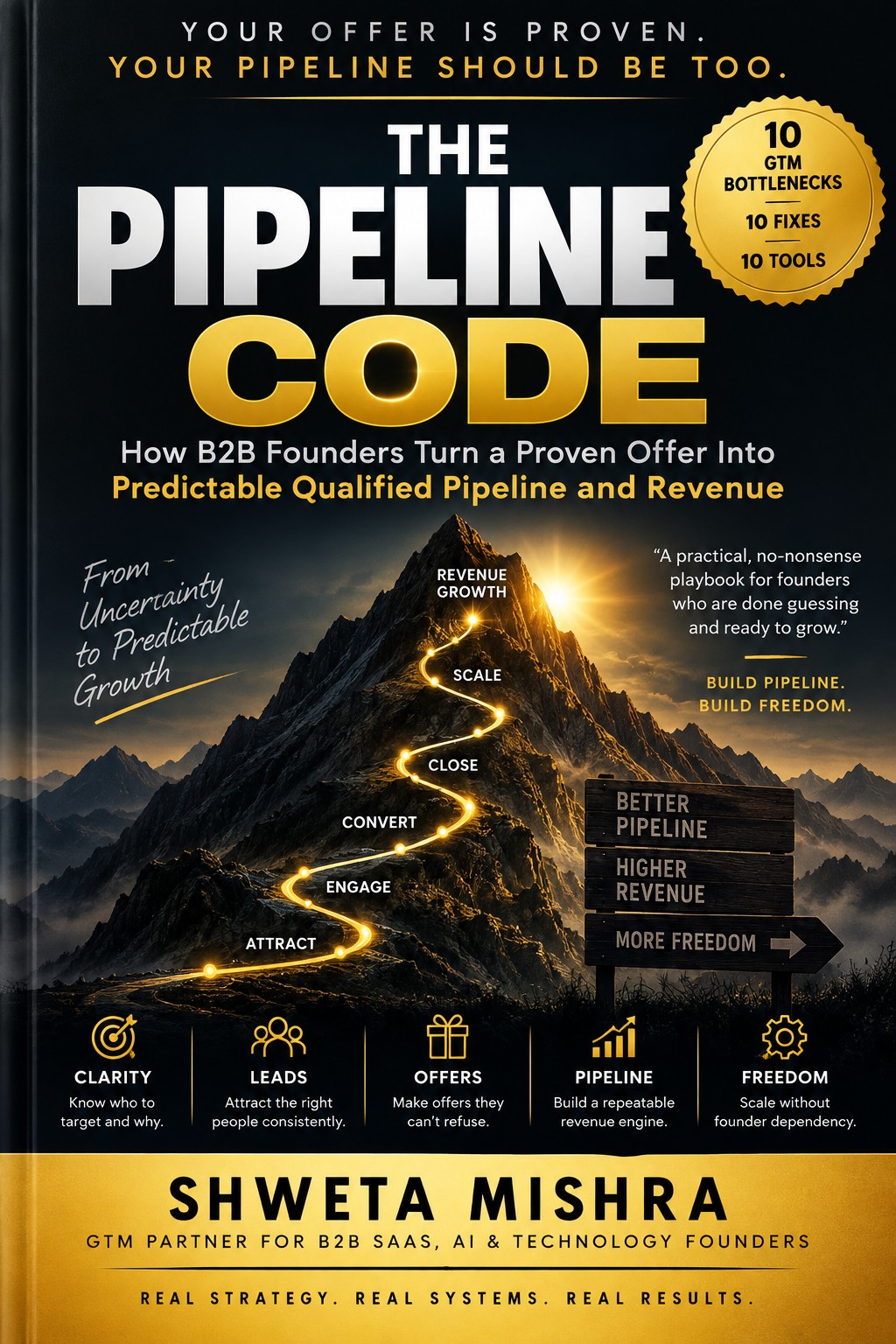
A pipeline is a system.
The book explains the code.
The Pipeline Code connects revenue math, high-probability ICPs, buying pain, offers, messaging and qualification into a practical operating approach.
Buy the Kindle edition on Amazon to explore the method. Apply it to your business through a focused GTM engagement.
Buy the Kindle book on Amazon ↗Commercial experience.
With context behind the numbers.
145%+ quota attainment
Reported revenue-target performance through prospecting, pipeline development and closure of high-value enterprise deals.
90%+ pipeline growth
Reported growth through strategic outbound outreach, opportunity qualification and lead conversion.
55%+ account revenue growth
Reported growth through account development, upselling and cross-selling initiatives.
Source: Shweta Mishra’s LinkedIn profile, supplied October 2026. These are self-reported results from prior employment, not client outcomes from this consulting engagement. Measurement periods and baselines are not specified in the profile. Past performance does not guarantee future results.
Shweta Mishra, MBA
GTM strategist, author and B2B technology sales professional with more than a decade of experience across SaaS, cloud, cybersecurity and technology markets.
Her experience spans full-cycle technology sales at Softchoice, B2B SaaS sales and account growth at utobo, founding GTM work at Thrive Trading, and relationship management at Practo.
That background brings a practical view of the full buying journey: selecting accounts, engaging senior stakeholders, qualifying opportunities, negotiating deals and developing customer revenue.
She holds an MBA in International Business from Trinity Western University and is the author of The Pipeline Code.
You'll work directly with Shweta to diagnose the bottleneck, agree a focused scope and build the next iteration of your GTM engine.
Let's find the gap
in your pipeline.
Built for B2B SaaS, AI and technology businesses with paying customers, a high-value offer and a pipeline constraint worth solving. Fit depends on your economics, needs and execution readiness.
A useful first conversation looks at your revenue target, current pipeline constraint and readiness for an ongoing partnership with a minimum initial 90-day commitment.
No promised meeting counts or guaranteed revenue. We agree realistic success measures from your baseline.
A few good questions.
What happens after the first 90 days?
We continue monthly under the agreed engagement terms: review signals and conversion, refine the ICP and messaging, improve stakeholder coverage and expand approaches supported by results. The first 90 days establish the foundation; ongoing work keeps the system relevant as your market changes.
What will you need from our team?
A clear owner, access to relevant commercial context, feedback on lead and meeting quality, and timely decisions. Channels, execution responsibilities, approved tools and any additional spending are agreed in the proposal.
What happens before we commit?
Prepare your brief, discuss your current constraint and agree fit. Shweta then proposes scope, responsibilities, investment and service terms. Payment follows agreement; the self-check does not create a contract.
Is this software, consulting or done-for-you execution?
The primary offer is an ongoing hands-on GTM partnership with Shweta, with a minimum initial 90-day commitment followed by monthly refinement under agreed terms. The Signal-to-Revenue workspace is in development, with account research, prioritization and messaging as intended capabilities. Execution responsibilities, channels and tooling are agreed in scope.
How is this different from buying another lead list?
The work connects your revenue target to a chosen segment, evidence of pain, timing, relevant messages and a qualification standard. A contact list is one input; the operating motion is the deliverable.
Are the career metrics results from consulting clients?
No. The figures shown are reported in Shweta’s supplied LinkedIn profile under her Softchoice experience. They describe prior employment and are not presented as consulting case studies or results produced by the developing app.
What results can you guarantee?
No specific pipeline or revenue outcome is guaranteed. We establish a baseline, agree deliverables and measures, and review what is working weekly. Outcomes depend on your offer, market, execution and sales conversion.
What does the engagement cost?
Pricing depends on scope, execution ownership and tooling. The first conversation establishes fit and commercial requirements before any proposal. Advertising spend and third-party tools are scoped separately.
What if we're too early for an ongoing partnership?
If you are still validating your product or don't have paying customers, start with The Pipeline Code and customer discovery. A hands-on pipeline engagement becomes more useful once there is a proven offer to build around.